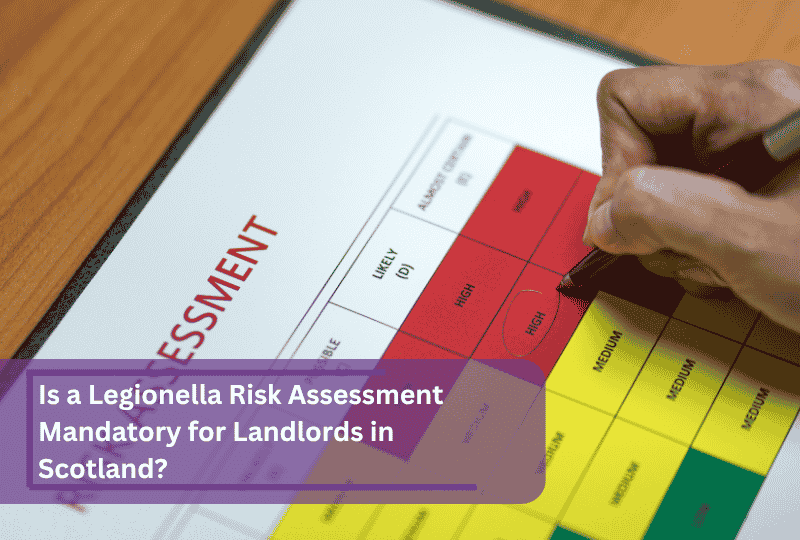
Yes, a legionella risk assessment is mandatory for every landlord in Scotland. It’s a legal duty, not just good practice, and it applies whether you own one flat or a whole portfolio.
For most rental properties, this doesn’t need to be a big undertaking. If your property has a combi boiler and no stored water, the assessment is usually quick, and you can carry it out yourself, only if you understand what to look for and keep a record of it.
In this guide, you will learn what Legionella is and why it matters in a rental property, what the law requires, which properties carry more risk, whether you can do the assessment yourself, what the assessment involves, and how to keep the risk low.
What Is Legionella and Why Is It a Concern in Rental Properties?
Legionella is a type of bacteria that lives naturally in water and soil. It is harmless in small numbers, but becomes dangerous when it grows inside man-made water systems. Such as the pipework, tanks, and water heaters found in most homes, and gets inhaled in tiny water droplets.
Breathing in contaminated droplets can cause Legionnaires’ disease, a serious form of pneumonia that can be life-threatening, particularly for older tenants, smokers, or anyone with an existing lung condition or weakened immune system.
The bacteria grow in water between 20°C and 45°C. Below 20°C, they stay dormant, and above 60°C, they’re killed off. This is why temperature control sits at the centre of almost every legionella prevention measure. Showers and taps are a particular concern, since they create a fine spray of water droplets that can be breathed in, while water that sits unused in pipework, often called a dead leg, gives the bacteria time and the right conditions to multiply.
Is a Legionella Risk Assessment a Legal Requirement in Scotland?
Yes, a legionella risk assessment is a legal requirement in Scotland. The duty comes from UK-wide health and safety law, not a Scotland-specific act. Under the Health and Safety at Work Act 1974 and the Control of Substances Hazardous to Health Regulations 2002 (COSHH), anyone in control of a property has to assess and control the risk from hazardous substances, and legionella bacteria fall under this.
In Scotland, this duty is also written directly into tenancy law. The Scottish Government’s Model Private Residential Tenancy Agreement states that the landlord must take reasonable steps, at the start of the tenancy and throughout it, to assess the risk of legionella exposure and keep the tenant safe.
This sits alongside your Repairing Standard duty under the Housing (Scotland) Act 2006, too, which requires you to keep the water system in proper working order, so a poorly maintained system that creates a legionella risk could put you in breach of both at once.
Which Rental Properties Need a Legionella Risk Assessment?
Every rental property needs some form of legionella risk assessment, but the level of risk and how much work goes into managing it depends almost entirely on the type of water system you have. A small flat doesn’t need anywhere near the same attention as a building with shared water tanks.
Standard Rental Properties and Low-Risk Water Systems
Most modern flats and houses have a low legionella risk. If your property has a combi boiler or an instantaneous electric shower, there’s no stored water sitting around for bacteria to grow in, since the water heats on demand rather than being held in a tank. Regular use also helps, since water moving through the system regularly doesn’t get the chance to stagnate. For these properties, the risk assessment is usually short, and the controls are simple.
Properties That May Present a Higher Legionella Risk
Risk increases in properties with a cold water storage tank, often found in the loft of older buildings, since stored water gives bacteria more time to grow if it isn’t managed properly. HMOs and properties with shared water systems carry more risk, too, since there’s more pipework and more outlets to manage.
Can a Landlord Carry Out a Legionella Risk Assessment Themselves?
Yes, for most domestic properties, you can carry out the assessment yourself, provided you’re competent to do so. This doesn’t mean holding a formal qualification. It means understanding the water system in your property, knowing what risk factors to look for, and being able to put basic control measures in place. The Health and Safety Executive provides guidance to help landlords do this without hiring anyone.
But for properties with more complex systems, a professional is needed. If your property has cold water storage tanks, is an HMO (House in Multiple Occupation), or shares a water system with other units in the building, a qualified assessor is worth bringing in.
They’re often accredited through the Legionella Control Association and bring the technical knowledge to handle these systems properly. For a larger portfolio, this is also often more efficient than learning the details yourself.
What Does a Legionella Risk Assessment Involve?
A legionella risk assessment really comes down to knowing your water system, spotting where the risk might build up, and checking the few basics that keep it under control. For most rental properties, that’s a quick job, nothing major.
Here’s how each stage of the legionella risk assessment breaks down.
Inspecting the Water System
The first stage is a visual survey of the property’s water system. This covers where the cold water comes in, how it’s heated, where it’s stored, if at all, and every outlet it reaches, including taps, showers, cylinders, and any outdoor connections. The goal is a clear picture of the whole system before anything else is checked.
Identifying Potential Risk Factors
The next step is to identify anything that could cause Legionella growth. Check for dead legs where water can sit unused. Look for redundant pipework that is still connected to the system. You should also inspect tanks and pipework for limescale, rust, sludge, or other debris, as these can provide nutrients for bacteria.
Checking Water Temperatures
Temperature checking is one of the most important parts of the legionella risk assessment. Using a probe thermometer, check the temperature of both hot and cold water outlets. Cold water should reach 20°C or below within two minutes of running the tap. Hot water should be stored at 60°C or above and reach at least 50°C or above at the outlet within one minute.
Bacteria multiply fastest between 20°C and 45°C, so any reading inside that range needs attention.
Evaluating Risks and Required Actions
Once the system has been inspected and the temperature has been checked, weigh up how much risk each issue actually poses. Consider whether any tenant is particularly vulnerable. For example, someone elderly or with a weakened immune system faces a higher risk of legionella than a healthy adult.
A dead leg feeding an outlet nobody uses needs a different response than a shower used daily but not recently cleaned. The goal is proportionate action, not a blanket response to everything found.
Recording Findings and Reviewing the Assessment
The final stage is documentation. This means writing down what was found, what was done about it, and when the action was taken. Kept alongside the original tenancy paperwork, this record is what actually demonstrates compliance if you’re ever asked to show it, since the law cares about evidence of an assessment, not just the fact that one was carried out.
How Often Should a Legionella Risk Assessment Be Reviewed?
There’s no fixed legal deadline for how often you need to review a legionella risk assessment, but reviewing it every two years is good practice for most domestic properties.
But you should review it sooner if anything changes that could affect the risk. A new tenant moves in, the water system is altered or repaired, the property sits empty for an extended period, or you notice a problem like a consistently low hot water temperature are all good reasons to review early.
Treating the review as a fixed two-year checkbox, regardless of what’s actually happening at the property, misses the point of having one.
How Can Landlords Reduce the Risk of Legionella?
A handful of simple, ongoing habits do most of the work in keeping legionella risk low, and none of them require any special equipment or training. Most come down to two things, which are keeping water at the right temperature and keeping it moving.
You can reduce the risk of Legionella by following these steps:
- Maintain Safe Water Temperatures: Keep hot water stored at 60°C or above and cold water below 20°C. This single measure does more to control Legionella than almost anything else.
- Flush Water Systems Regularly: Make sure to run taps, showers, and toilets for a few minutes if a property has been empty for more than a week, and flush the whole system before a new tenant moves in.
- Remove Redundant Pipework: Any pipework no longer in use but still connected to the system should be removed, since it creates exactly the stagnant conditions Legionella needs.
- Keep Water Moving: Outlets that aren’t used often, such as in a spare room or outbuilding, should still be run at least once a week to stop water from sitting still.
- Maintain Tanks and Outlets: Keep cold water tanks covered with a tight-fitting lid to stop debris from getting in, and encourage tenants to clean and descale showerheads regularly.
Build these into your routine inspections, and you’re covering most of what a risk assessment is checking for anyway.
Conclusion
A legionella risk assessment is a legal requirement for every landlord in Scotland, but for most rental properties, it doesn’t need to be complicated or expensive. You need to understand your water system, check it for the main risk factors, keep temperatures within a safe range, and write down what you find. Skipping this, or assuming it doesn’t apply because the property is small or simple, is what leaves landlords exposed if something goes wrong.
Landlords who manage this well aren’t doing anything difficult; they are just consistent. Checking temperatures, flushing unused outlets, and reviewing the assessment regularly take very little time once they’re part of your routine, and that routine is what actually keeps tenants safe.
If you are a landlord in Dundee or the surrounding area and want help managing legionella risk, or property maintenance more broadly, Westport Property is here to help. With over 13 years of experience managing rental properties in the local area, our team can help you carry out a proper risk assessment, put the right control measures in place, and keep your records up to date.
Have A Question or Need Some Help?
Whether you're searching for the perfect rental property or a landlord wanting advice on letting, we're here to assist. Feel free to call our office or send us an email, and we'll be happy to help you with any queries you may have.
Frequently Asked Questions
Is there a Legionella Risk Assessment certificate?
No. There's no such thing as a legally required Legionella certificate, and the Health and Safety Executive has confirmed this directly. The law requires a documented risk assessment, not a certificate from a third party. Some companies sell certificates as a commercial product, but a landlord who carries out their own assessment and keeps a written record has met the same legal duty.
Does a Legionella risk assessment cover gas safety or electrical checks too?
No. A legionella risk assessment only covers the risk from bacteria in the water system. Gas safety checks and Electrical Installation Condition Reports (EICRs) are separate legal requirements with their own certificates and renewal timelines, and none of them substitutes for the others.
What happens if a tenant gets Legionnaires' disease in a rental property?
If a tenant becomes ill and an investigation finds the landlord failed to carry out or act on a proper risk assessment, this can lead to prosecution under the Health and Safety at Work Act, with penalties including unlimited fines. It can also expose the landlord to a civil claim for damages from the tenant.
Does a Legionella risk assessment need to be repeated for every new tenant?
Not necessarily as a brand new assessment each time, but a change in tenant is one of the triggers for reviewing the existing one. At a minimum, flush the system before a new tenant moves in and check that nothing has changed since the last review.
 Find a Property Sale/Rent
  Property Management
  Tenant Background Screening
  Rent Collection
  Property Maintainance
  Property Inspection
  Property Advertising
  Portfolio Management For Landlords
  Investment & Asset Management